Encryption is the bedrock of data protection across both the private and public sectors. As cyber threats grow in sophistication and scale, the algorithms that safeguard financial transactions, classified intelligence, health records, and critical infrastructure are under unprecedented scrutiny. For defense contractors, government agencies, and the technology providers that support them, understanding the current encryption landscape is not merely a technical exercise — it is a strategic imperative.
Today, organizations rely on a multi-layered cryptographic approach that combines symmetric encryption (principally AES) for high-speed bulk data protection, asymmetric encryption (RSA, ECC) for secure key exchange and digital signatures, and hybrid models that unite the strengths of both. These mechanisms protect data at rest and in transit across every layer of the modern technology stack, from TLS-secured web traffic to encrypted storage volumes and signed firmware images.
However, the emergence of quantum computing introduces a paradigm-level threat to this foundation. A sufficiently powerful quantum computer running Shor’s Algorithm could break the mathematical problems underpinning RSA and ECC in a fraction of the time required by classical machines — rendering current asymmetric encryption obsolete. Symmetric algorithms such as AES-256 are more resilient; Grover’s Algorithm provides only a quadratic speedup to brute-force key search, reducing effective security from 2256 to 2128 — a level that remains computationally infeasible.
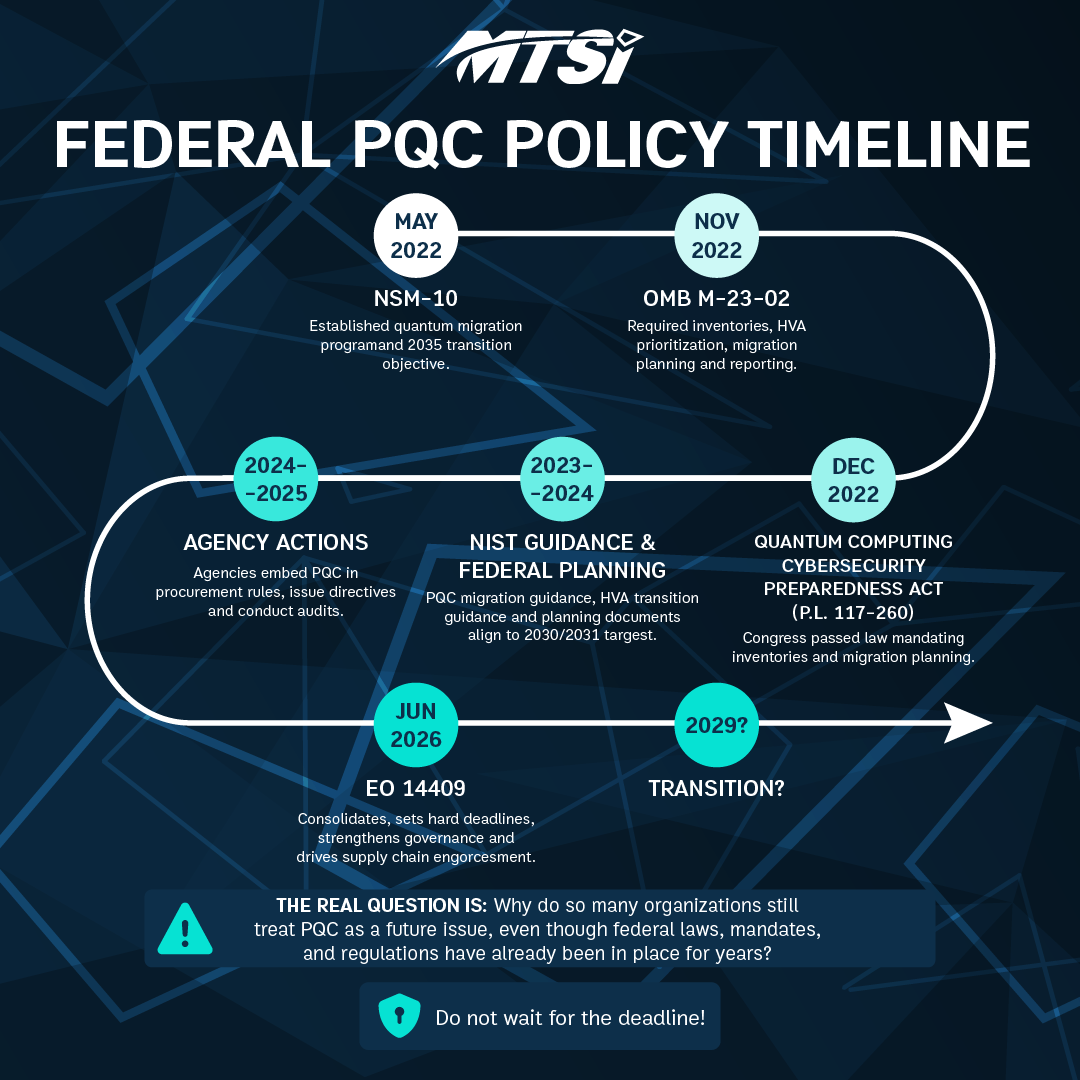
The U.S. government has responded decisively. The NSA’s CNSA 2.0 roadmap mandates a phased transition to quantum-resistant algorithms — including ML-KEM (CRYSTALS-Kyber) for key establishment, ML-DSA (CRYSTALS-Dilithium) for digital signatures, and LMS/XMSS for software and firmware signing — with full migration across all National Security Systems targeted by 2035.
The timeline for action has compressed dramatically. In March 2026, Google — which simultaneously operates one of the world’s most advanced quantum computing programs and maintains critical global internet infrastructure — announced a hard target of 2029 to complete its post-quantum cryptography migration, a full year ahead of NIST’s planned deprecation and six years ahead of the final disallowance deadline. This signal from a company uniquely positioned at the intersection of quantum hardware development and global-scale infrastructure defense underscores that the transition window is shorter than most organizations have planned for.
This white paper provides a comprehensive analysis of the modern encryption landscape, the nature and timeline of the quantum threat, the government’s evolving cryptographic standards, and actionable guidance for organizations preparing for the post-quantum era.
Beyond the immediate CNSA 2.0 migration imperative, a second emerging capability warrants strategic attention: Homomorphic Encryption (HE). While post-quantum algorithms address the security of data in transit and at rest, HE closes a third and final gap — protecting data while it is actively being processed. By enabling mathematical operations to be performed directly on ciphertext, HE eliminates the requirement to decrypt data before computation, removing the plaintext exposure window that exists in every conventional processing architecture. Though still maturing — with current Technology Readiness Levels of 4–6 — HE is advancing rapidly under DARPA DPRIVE and IARPA investment programs, and NSA has identified it as a priority privacy-enhancing technology. Organizations building long-term cryptographic architectures should begin tracking HE scheme development and piloting use cases now.